Check a model's live status before you call
The old availability card could show a model as up when we did not know its state; now a model's page names its Service Status when something is wrong, and a public API answers for up to 50 models in one call.
Models now carry a Service Status, so you or your agent can read whether a model is accepting requests before sending one. It shows on the model page when something is wrong, and two public endpoints answer it for one model or up to 50 in a single call, with no API key.
Read it on the model page
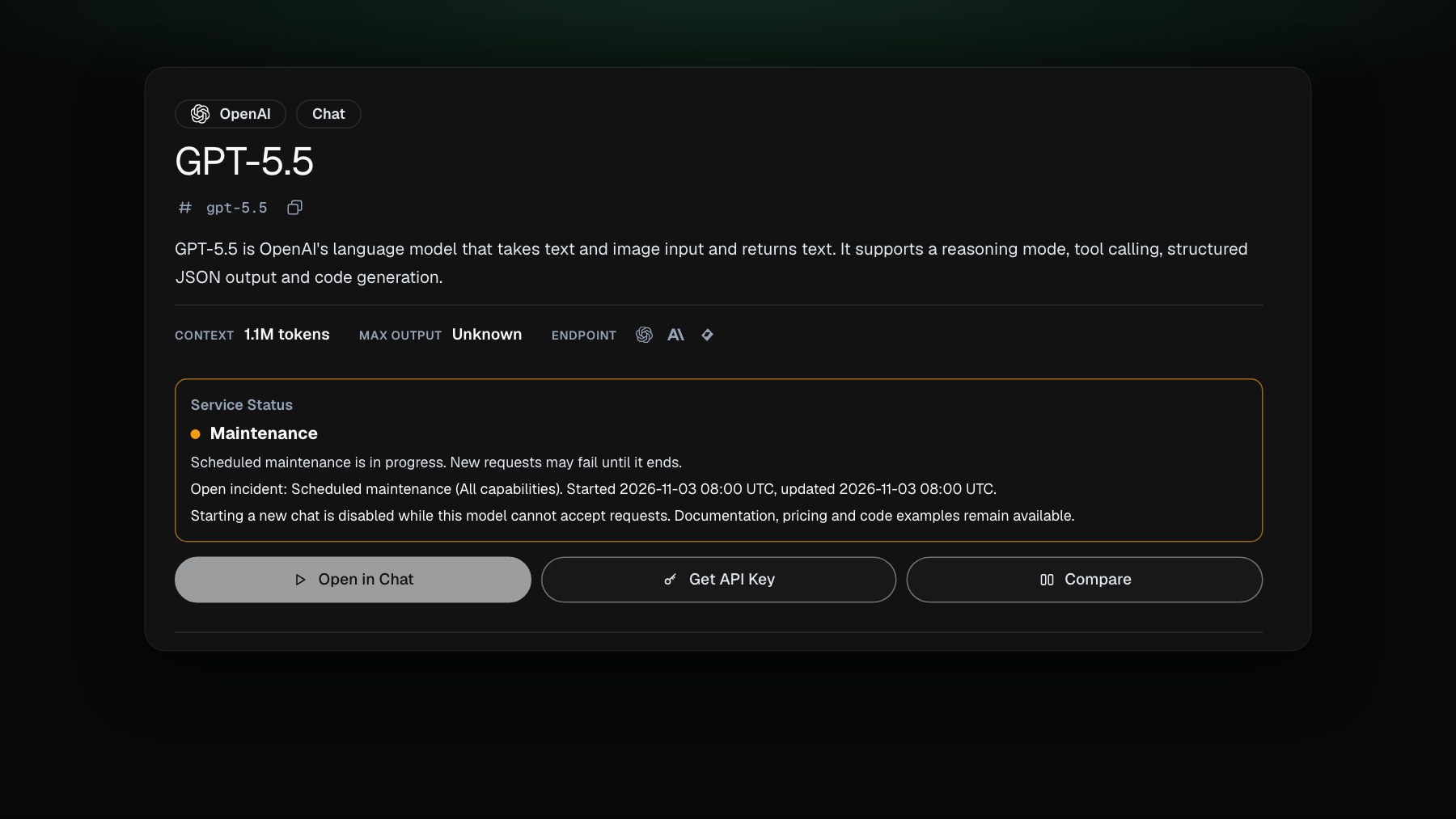
A model that is degraded, in recovery verification, in maintenance or temporarily unavailable shows its Service Status in the model's header, with the title and the actions and above pricing and the code tabs, with the reason in plain words and, when only part of the model is affected, which capability. A model that is accepting requests shows nothing there.
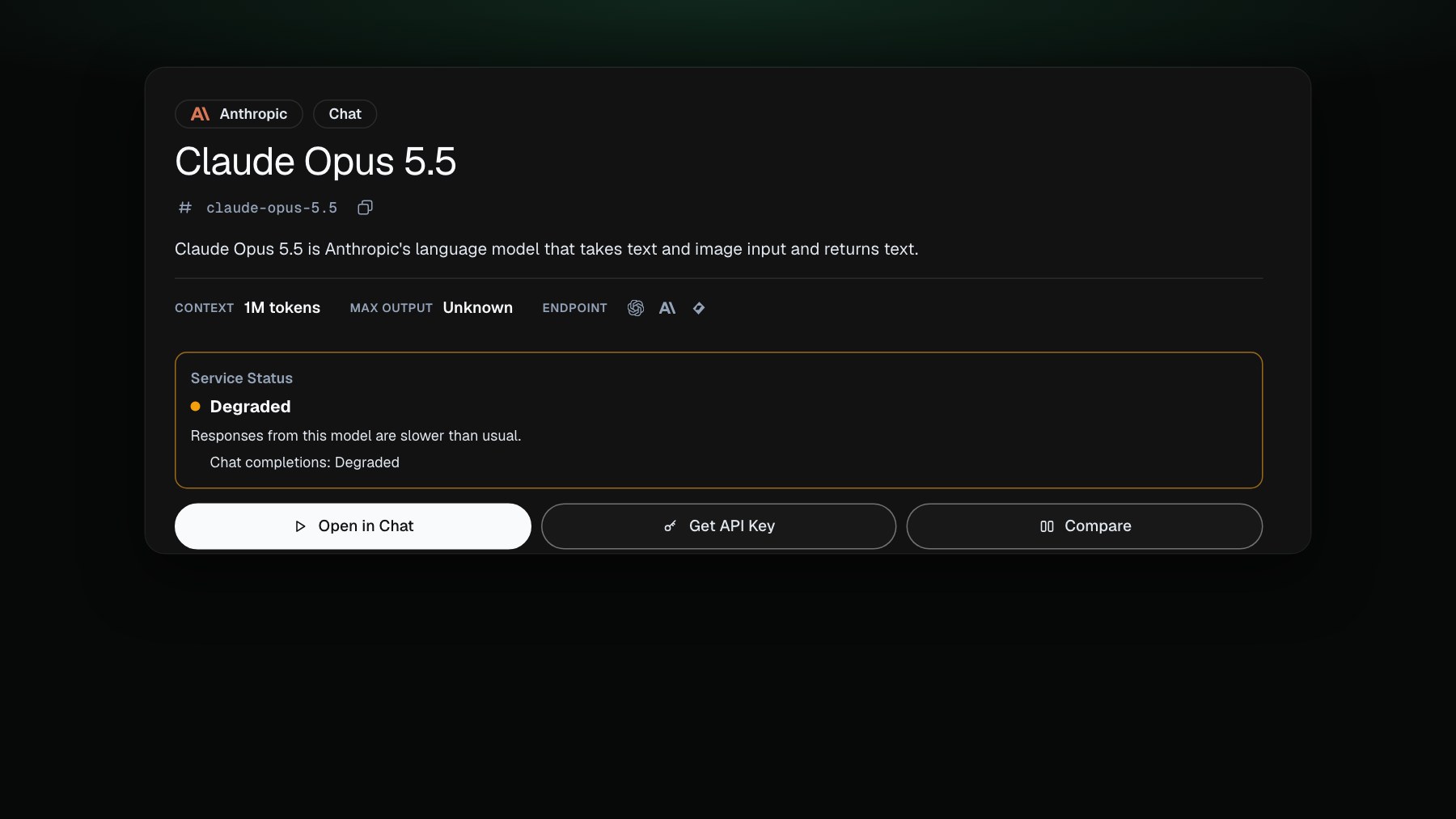
While a model, or its chat completions, is temporarily unavailable or in maintenance, Open in Chat is disabled, and the page says why: "Starting a new chat is disabled while this model cannot accept requests. Documentation, pricing and code examples remain available."
What each label means
| Label | service_state | reason_code, and its message |
|---|---|---|
| Accepting requests | accepting_requests | no_known_incident: "No known service incident." |
| Degraded | degraded | partial_failure: "Some requests to this model are failing. Retries may succeed." latency_degradation: "Responses from this model are slower than usual." |
| Temporarily unavailable | unavailable | no_eligible_route: "No serving route is available for this model right now, so new requests will fail." service_incident: "A service incident is affecting this model. New requests are likely to fail." |
| Recovery verification | recovering | recovery_verification: "A fix is in place and recovery is being verified. Service may not be fully restored yet." |
| Maintenance | maintenance | scheduled_maintenance: "Scheduled maintenance is in progress. New requests may fail until it ends." |
| Status information temporarily unavailable | null | status_sync_unavailable: "Apertis cannot confirm the current service state. This is not a report that the model is down." initialization_pending: "Service status for this model has not been established yet. This is not a report that the model is down." |
When we cannot tell, the API says so (service_state: null) and the page shows no status rather than showing a model as up: the old availability card could show a model as up when we did not know its state. A model that was accepting requests is never reported as accepting from a stale answer, and reporting_state (current, delayed or unavailable) says whether the status itself is up to date.
Ask the API
GET /api/v2/models/{id}/service-status answers for one model, and GET /api/v2/model-service-status?model_ids=a,b,c for several. Neither needs a key.
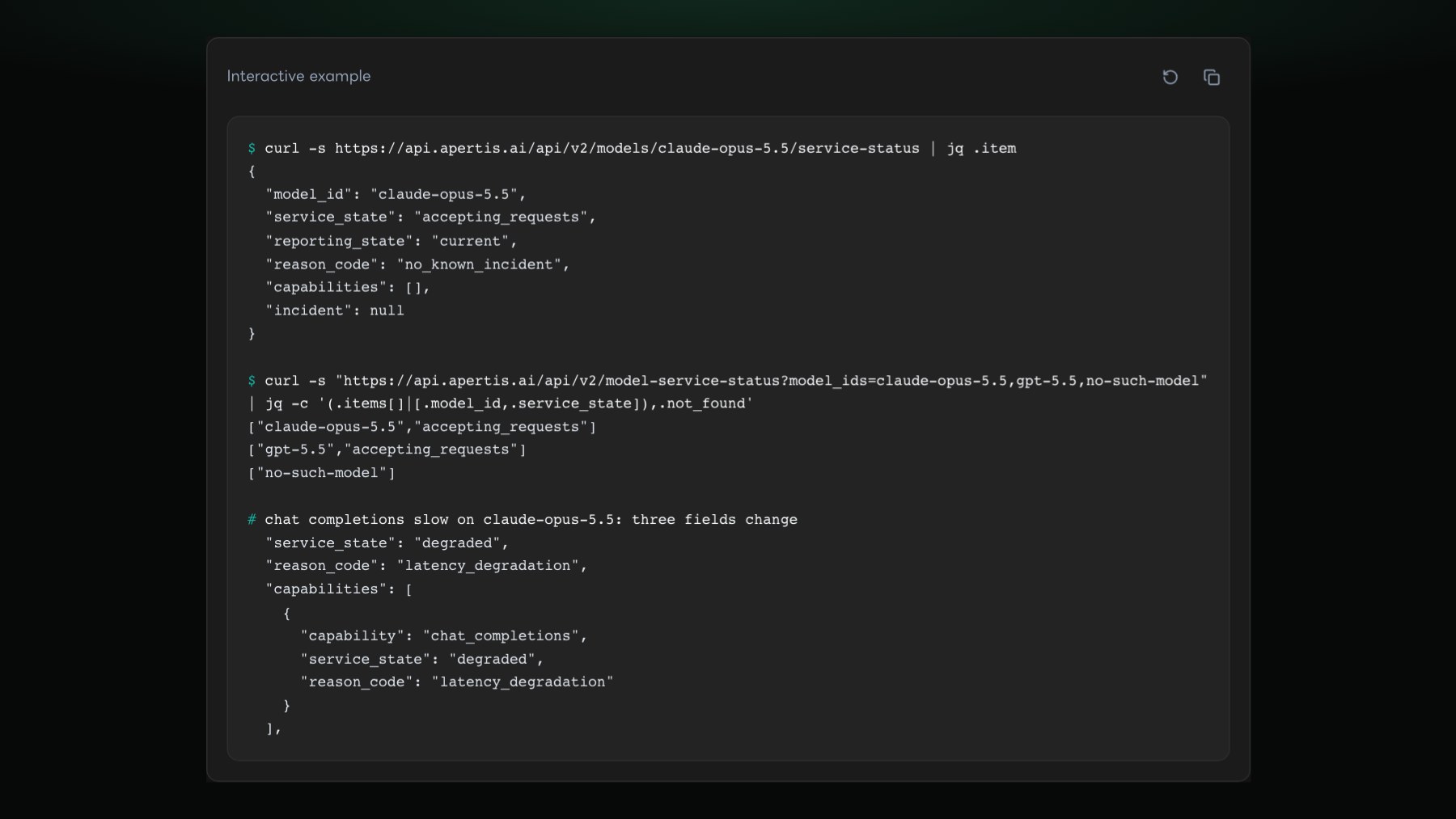
curl -s https://api.apertis.ai/api/v2/models/claude-opus-5.5/service-status | jq{
"schema_version": 1,
"snapshot_generated_at": "2026-11-22T10:19:08.790508896Z",
"item": {
"model_id": "claude-opus-5.5",
"service_state": "accepting_requests",
"reporting_state": "current",
"reason_code": "no_known_incident",
"capabilities": [],
"incident": null
}
}The batch returns items and a not_found list in the order you asked. An id that does not exist or is not public lands in not_found, not in an error:
curl -s "https://api.apertis.ai/api/v2/model-service-status?model_ids=claude-opus-5.5,gpt-5.5,no-such-model" | jq -c '.items[].service_state, .not_found'"accepting_requests"
"accepting_requests"
["no-such-model"]| Field | What it holds |
|---|---|
snapshot_generated_at | When the status snapshot behind the answer was generated, in UTC. It is not the time of a request to the model. |
service_state | accepting_requests, degraded, unavailable, recovering, maintenance, or null when the state cannot be established. |
reporting_state | current, delayed or unavailable. |
reason_code | One of the nine reasons in the table above. |
capabilities | The capabilities that are not accepting requests, each with its own capability, service_state and reason_code; [] when the whole model has one state. A capability is chat_completions, responses, messages, embeddings, rerank, images_generations, audio_speech, audio_transcriptions, video_generation, tool_calling or streaming. |
incident | null, or id, reason_code, capabilities, started_at, updated_at and resolved_at, which is null while the incident is open. |
| Batch rule | Value |
|---|---|
model_ids | Required; comma-separated, repeated, or both. A repeated id counts once. |
| Ids per call | Up to 50. |
| Length of an id | Up to 256 bytes. |
| Matching | Exact. An alias, a provider-prefixed id and a :free id are separate models with separate statuses. |
A call outside those limits is refused, never cut short, so you never get an answer that leaves out an id you asked about.
| Status | Body | When |
|---|---|---|
| 200 | item, or items and not_found | The answer. Cache-Control: public, max-age=<seconds>, the time left in the current snapshot. |
| 400 | {"schema_version":1,"error":{"code":"invalid_request"}} | A batch with no id, an empty id, an id over the length limit, or more ids than the limit. |
| 404 | {"schema_version":1,"error":{"code":"not_found"}} | One model that does not exist or is not public; the answer is the same for both. |
| 503 | {"schema_version":1,"error":{"code":"status_unavailable"}} | The status cannot be read right now. |
| 429 | empty | Too many requests from your address; wait the seconds in Retry-After. |
Every error the status endpoints answer is Cache-Control: no-store and carries a code and nothing else; a 429 from the API's rate limit has an empty body and a Retry-After header. Treat an error, a timeout and a null service_state as "cannot tell", not as down and not as up; the model page does the same. The old GET /api/v2/models/{id}/availability now answers 410 and points here.
Pricing and models as Markdown
For agents that read pages instead of calling an API: /pricing.md serves the plans and the pricing FAQ as Markdown, the same document as /subscribe.md, and /models.md lists the catalogue with token prices per 1M tokens (a model priced per request shows its price per request). Both answer as text/markdown, and llms.txt links them. A model priced per token also carries its prices as Product and Offer structured data on its page.