Cost calculator for a month of agent traffic
You can now price a month of input and output tokens across a curated set of models, with open models beside Claude Sonnet 5.5, on a public page that needs no account.
Your bill depends on how many input and output tokens you send, so the comparison that helps is one workload priced across many models, before you pick one. apertis.ai/calculator takes two monthly token volumes and prices every model in its tables against them at once, with open models next to Claude Sonnet 5.5 as the reference. No account is needed.
To start, open the page and set the two volumes, or pick a preset. An agent can read the rates as Markdown at https://apertis.ai/calculator.md.
Set your workload
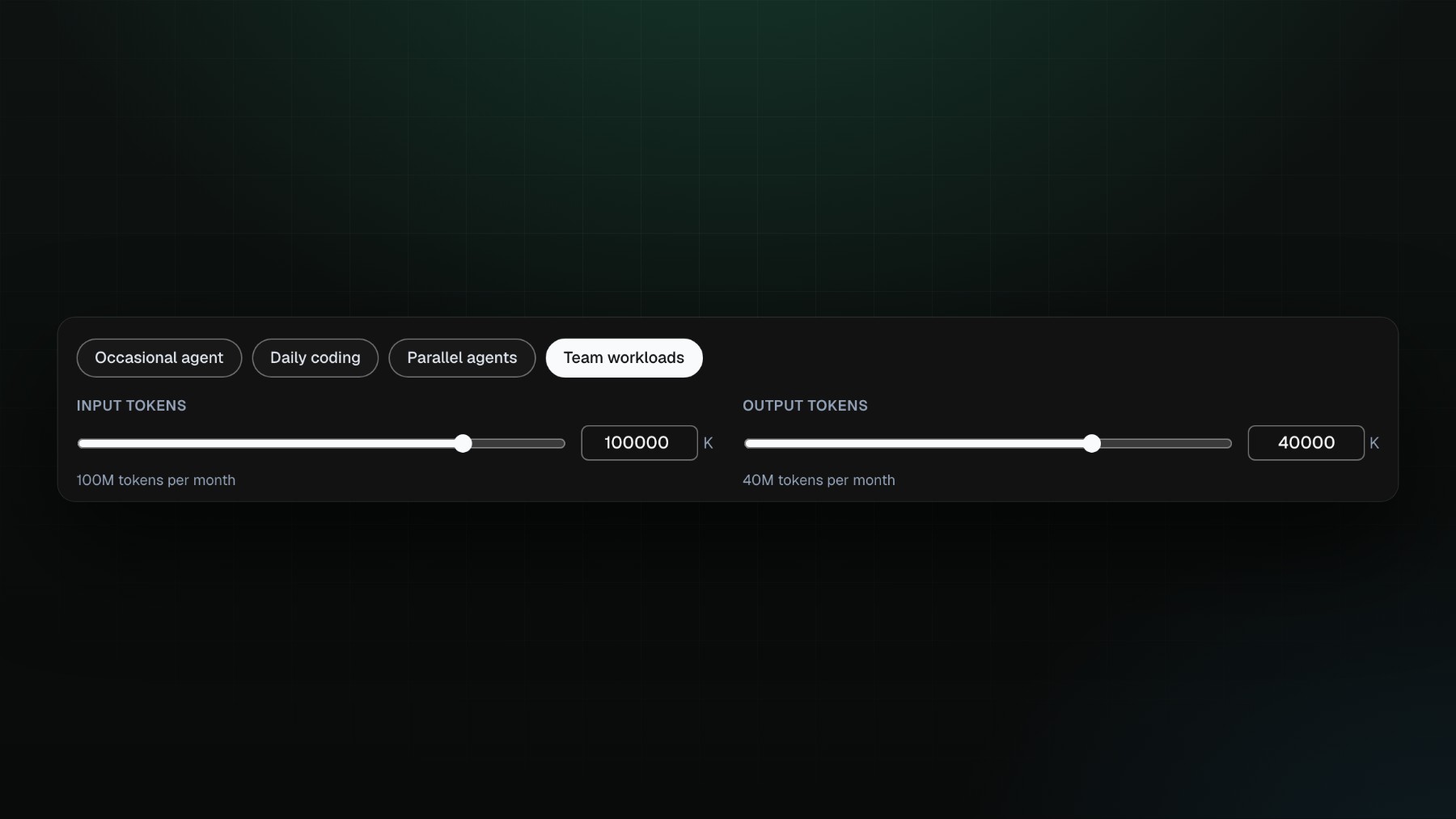
| Field | Unit | Range | Default |
|---|---|---|---|
| Input tokens | thousands of tokens per month | 10 to 1,000,000 (10K to 1B tokens) | 100,000 (100M) |
| Output tokens | thousands of tokens per month | 10 to 1,000,000 | 40,000 (40M) |
Each field has a slider and a number box. The slider is logarithmic and snaps to three significant figures. A typed value is rounded to a whole number and clamped to the range.
Four presets fill both fields (input / output, in K tokens): Occasional agent 500 / 200, Daily coding 5,000 / 2,000, Parallel agents 25,000 / 10,000, Team workloads 100,000 / 40,000. The page opens on Team workloads. There is no cached-token field.
See how a month is computed
monthly = input_rate x (input_K / 1000) + output_rate x (output_K / 1000)Rates are USD per 1M tokens. At the default workload, a model at $2.00 in and $10.00 out costs 100 x 2.00 + 40 x 10.00 = $600.00.
Compare open models with Claude
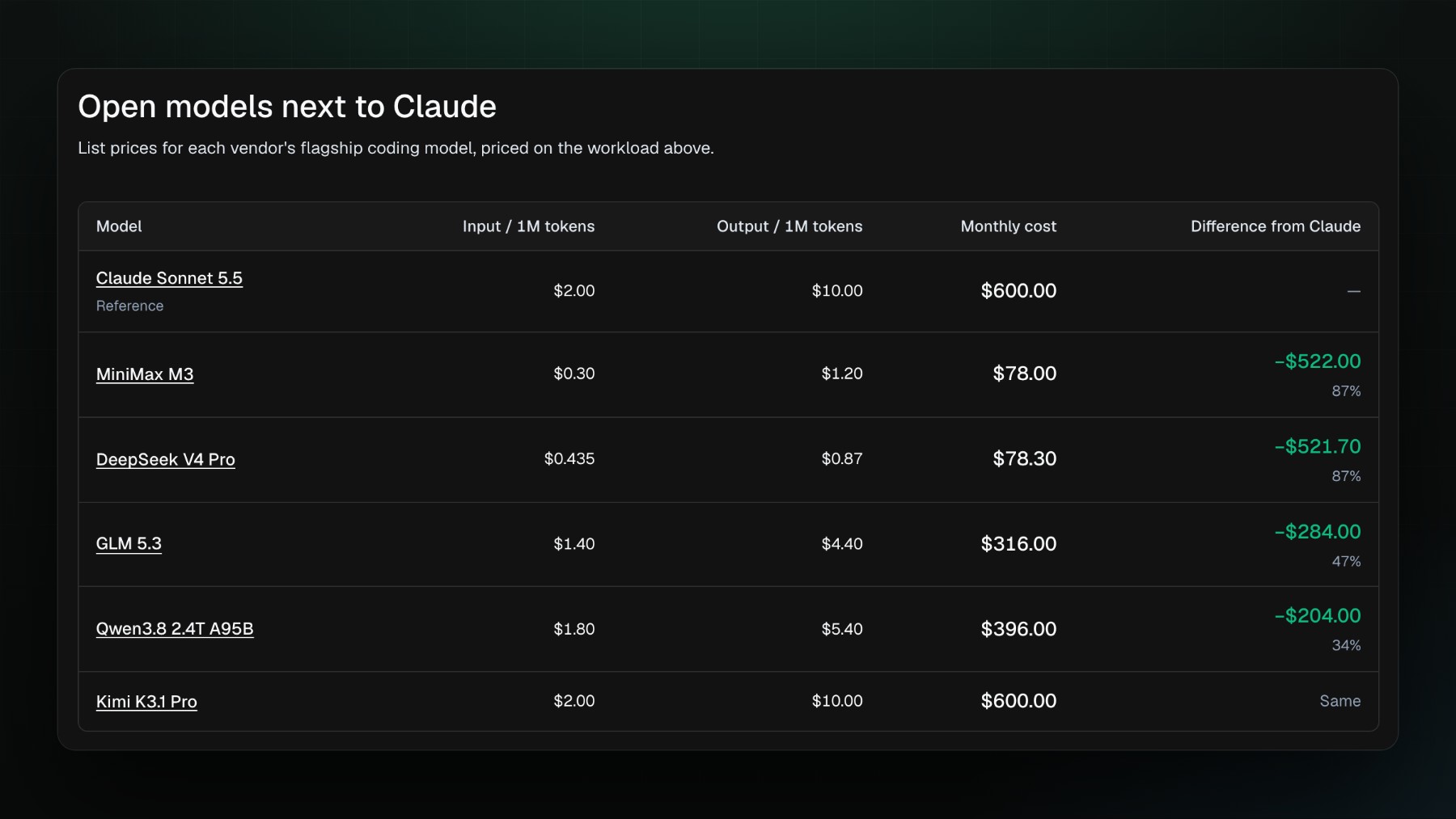
One table prices one flagship per open-model vendor on the same workload, at Apertis list rates, against Claude Sonnet 5.5 as the reference.
| Vendor | Model ID |
|---|---|
| GLM | glm-5.3 |
| Kimi | kimi-k3.1-pro |
| DeepSeek | deepseek-v4-pro |
| MiniMax | minimax-m3 |
| Qwen | qwen3.8-2.4t-a95b |
Columns: input and output rate per 1M, monthly cost, and the difference from Claude in dollars and as a share. The Claude row is first, then the open models, cheapest first. A vendor whose flagship is not in the catalog is shown as not listed; it is never replaced by another model.
Compare Apertis totals with the market list rate
A second table holds up to seven chat models, one per provider (the provider's newest), with OpenAI, Anthropic and Google always included when they qualify. Free and per-request models are left out. Rows are sorted by Apertis total, cheapest first.
Beside the Apertis total, a Market list column prices the same workload at the model's public list rate, and a Difference column gives the Apertis total minus the market total. Under half a cent it reads Same. The line under the table reads "Both read YYYY-MM-DD": the UTC date the page read the Apertis catalog and the market source, one date for both.
When the market source does not answer, the Market list column reads Not available, with a note that this does not mean the market has no priced models. The Apertis column still renders.
Know what bonus credit does to a total
Every total is a list price. Bonus credit on an Add Credits purchase is added on top of what you buy and never changes a total in these tables; the page shows the current schedule.
Read the rates from an agent
GET /calculator.md returns text/markdown; charset=utf-8. It lists per-1M rates for each model in both tables, the formula and the read date. It takes no workload and prints no monthly totals.
State and limits
The inputs are not in the URL: there are no query parameters, and a reload returns to the default workload.
The page states its own limit: it is a reference estimate. A bill depends on the current access option, included usage, overflow terms, the routed provider and actual cache behavior. It is not a quote or a guaranteed savings calculation.