Open models, verified in public
You can now see which model and which source answered an open-model request, then match it to a dated public report of checks. Three response headers name the answer.
An open model can be served by more than one source, so when an answer looks off, the first question is which source gave it.
An answer for an open model carries three headers that name the model and the source that answered. They are written before the first byte, so a streamed response has them too. The report at apertis.ai/verification lists what we checked for each model on each source, so you can read the result for the source that served you.
To start, send a request and read the headers:
$ curl -i https://api.apertis.ai/v1/chat/completions \
    -H "Authorization: Bearer $APERTIS_API_KEY" \
    -H "Content-Type: application/json" \
    -d '{"model":"glm-4.7","messages":[{"role":"user","content":"Say ok."}],"max_tokens":16}'

HTTP/2 200
x-apertis-served-model: glm-4.7
x-apertis-source: aggregator-a
x-apertis-source-type: aggregator
The header values above are an example; your response names the source that answered your request. To match it, read the model and the label, find the row with that model and that label in the results table, then read its checks and its run date.
Read the receipt headers
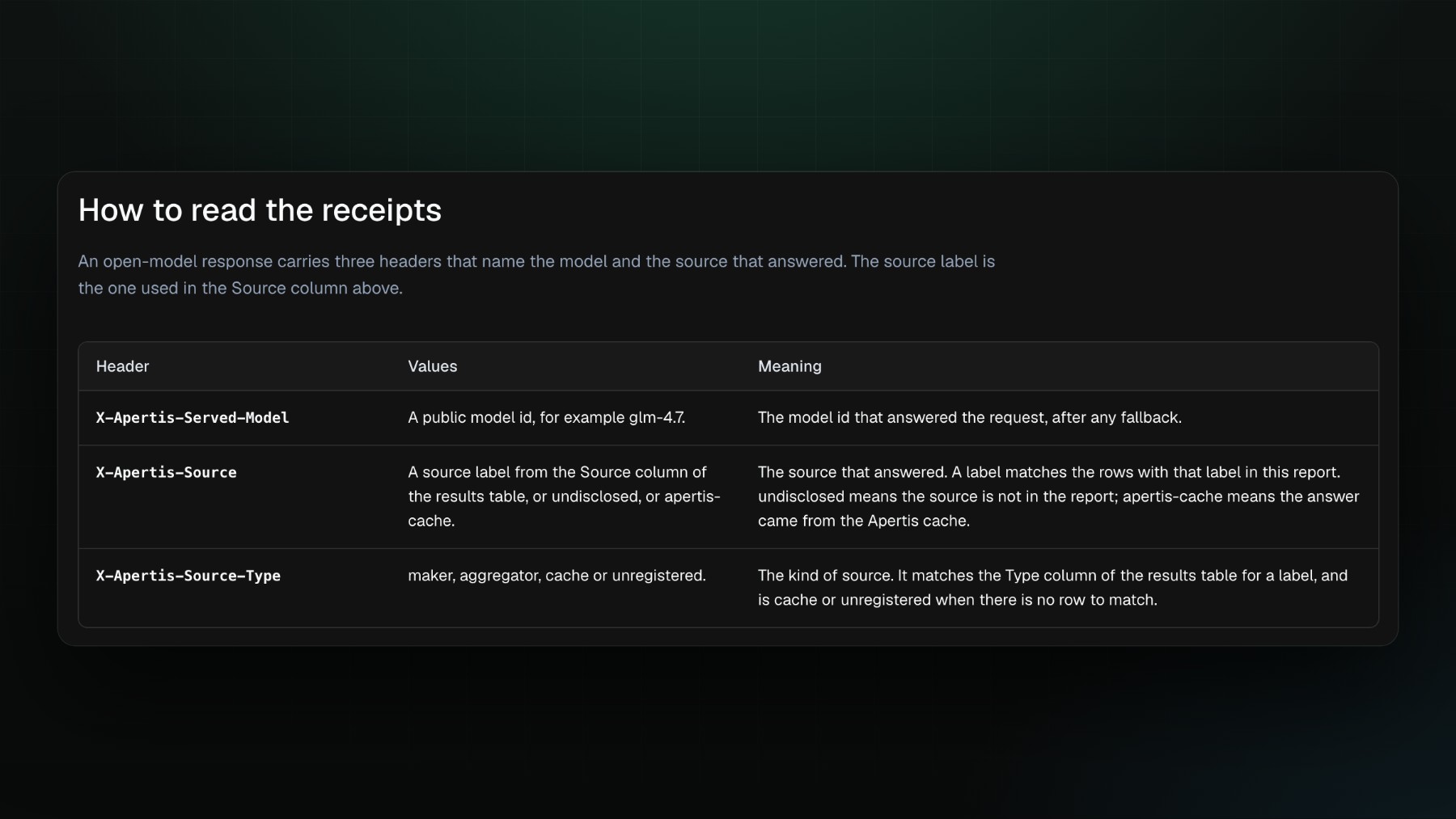
| Header | Value |
|---|---|
X-Apertis-Served-Model | The public model id that answered, after any fallback. |
X-Apertis-Source | A source label from the report's Source column; undisclosed when the source is not in the report; apertis-cache when the answer came from the Apertis cache. |
X-Apertis-Source-Type | maker, aggregator, cache or unregistered. |
They appear on /v1/chat/completions and /v1/messages, and are listed in Access-Control-Expose-Headers, so browser code can read them. Claude models carry no receipt, and neither does a response with no answer in it, such as an error.
Find your source in the report
An agent can read the same report as Markdown at apertis.ai/verification.md. Both render one generated data file; no result is typed by hand.
One row is one model on one source for one run. A row carries the model, the source label, the source type, the run date, and the five results below. The first publication has two rows for glm-4.7, run on 2026-11-08.
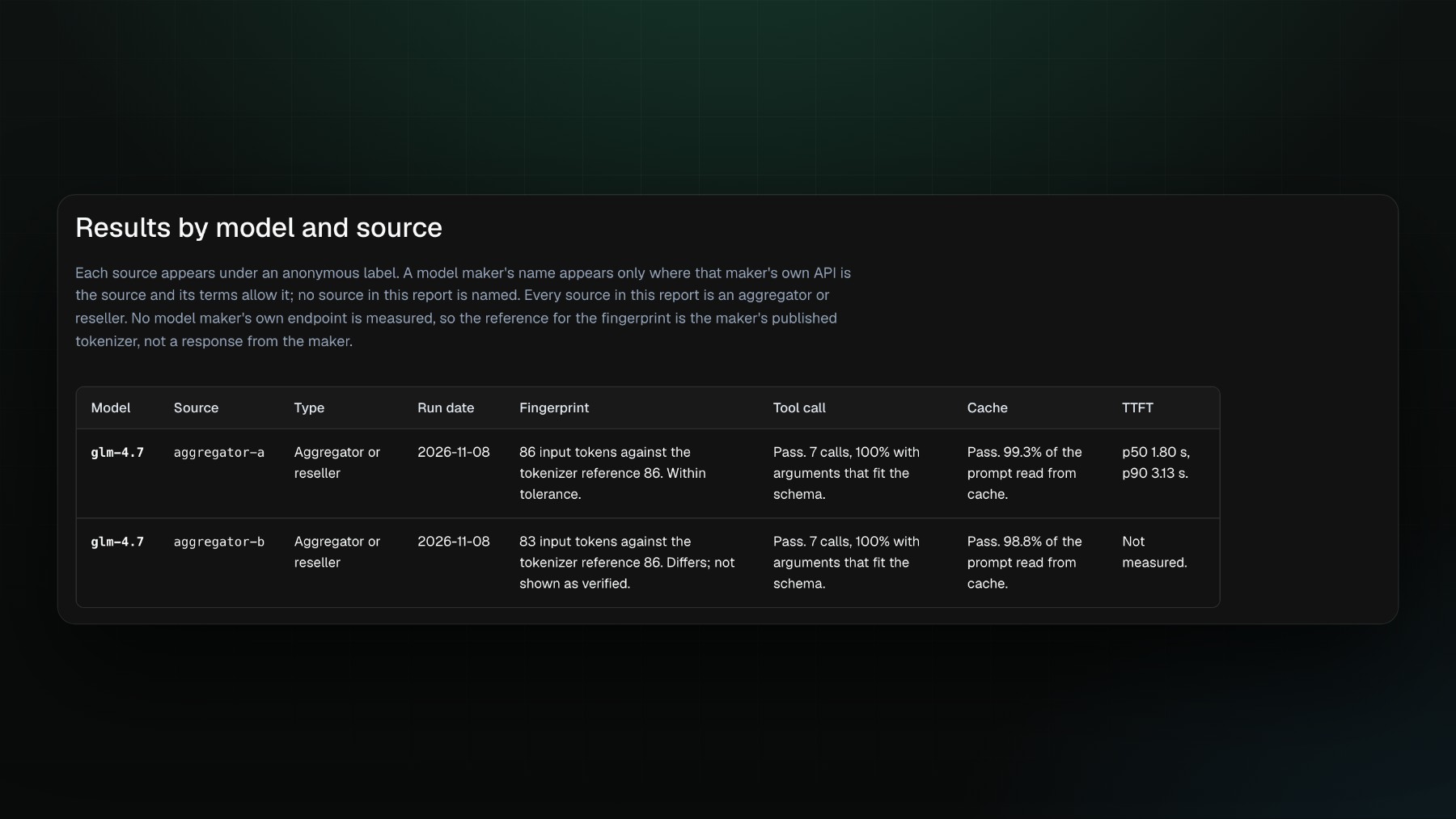
Sources appear under anonymous labels such as aggregator-a. A model maker's name appears only where that maker's own API is the source and its terms allow it. In this publication every source is an aggregator or reseller, so none is named and no maker's own endpoint is measured. The reference is the maker's published tokenizer, not a response from the maker.
Know what each check measures
| Check | How it is run | What the row shows |
|---|---|---|
| Input token count | One fixed prompt, printed in full on the page, mixing scripts, emoji, code and numbers. usage.prompt_tokens is read from the source and compared with the count from the maker's published tokenizer at a pinned revision. | Within tolerance when within 2 tokens or 3% of the reference, whichever is larger. Outside it, the row says the count differs and is not shown as verified. A model with no pinned reference shows its count and no verdict. |
| Tool call | One declared function, a second turn with the tool's result. | Pass or fail, the number of calls in the run, and the share of arguments that fit the declared schema. |
| Cache | The same prompt of about 7,000 tokens, sent three times, two seconds apart. Calls two and three must report cached tokens; a prompt with another first line must report none. | Pass or fail, and the share of the third call's prompt read from cache. |
| Time to first token | For each streamed request that returned 200, the time from sending to the first chunk. | Median (p50) and 90th percentile (p90), or not measured. |
| Availability | Calls that returned 200, divided by calls that returned 200, a 5xx or a 408. A 429 is counted separately. | The ratio, the number of calls and the number of server errors. |
In the first publication one source matches the reference (86 tokens against 86) and one does not (83 against 86). A count that differs means the source wrapped or split the same prompt differently, for example with another chat template. It does not say which model answered.
Rerun the fingerprint yourself
Send the report's fingerprint prompt with max_tokens set to 16 and compare usage.prompt_tokens with the reference. The page lists, per model, the tokenizer repository, the pinned revision and the chat template with its SHA-256 (for glm-4.7: zai-org/GLM-4.7, 86 tokens), and a request block ready to copy.
What a row does not tell you
Each row is a snapshot of one run on the date shown; a source can change afterwards. A row describes one model on one source and says nothing about other models on that source. The report is regenerated when a model or a source is added, and each publication is a dated snapshot.